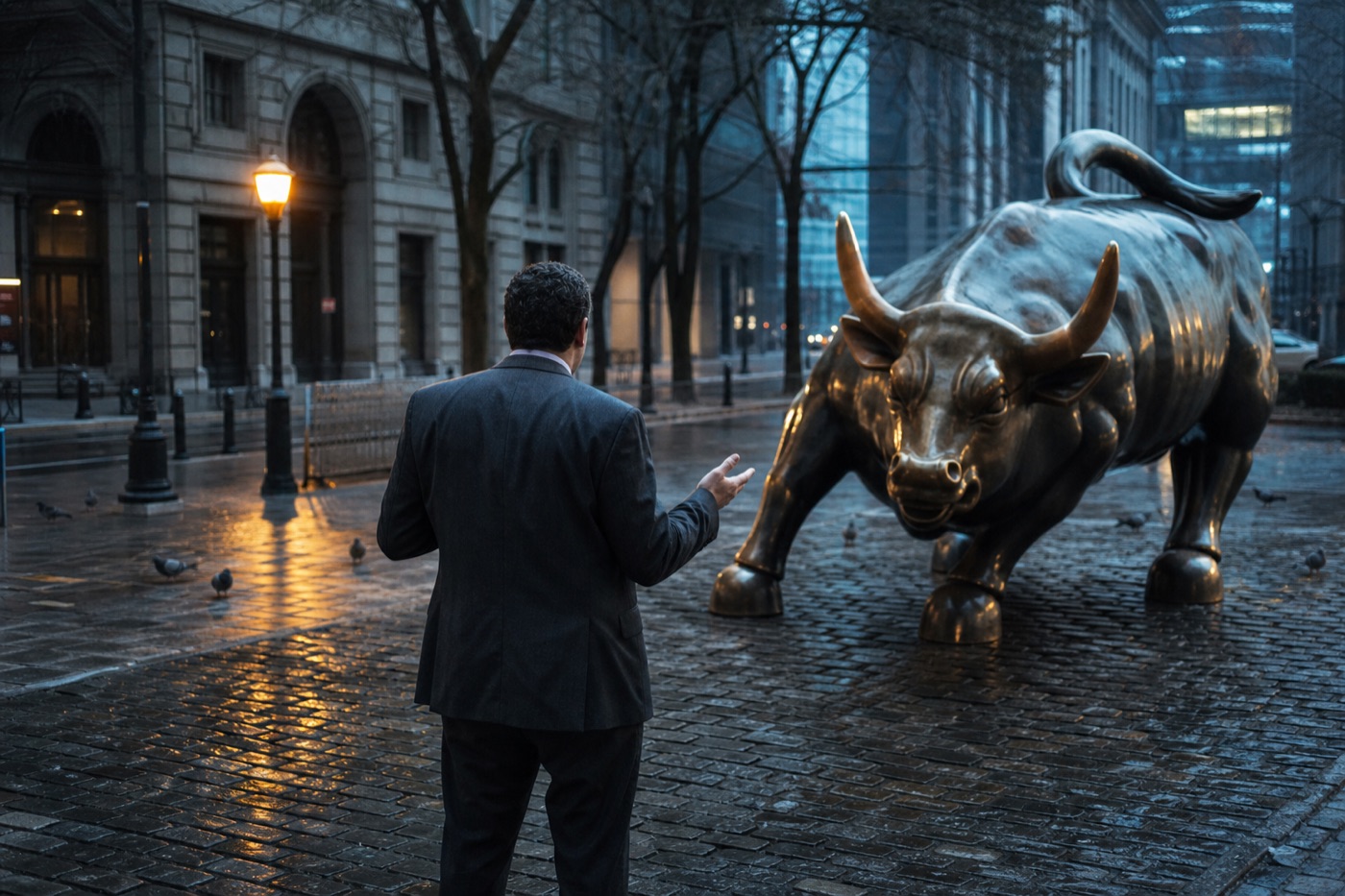
The people who worked with Duncan Horst describe the same afternoon. He was in a stakeholder meeting on a Tuesday, and he began to speak, and he did not stop for the better part of six hours. What he said — that the market's bronze bull was a real god, humanity's oldest, and that it was being kept alive on the wrong kind of worship — did not, at first, alarm anyone. He was a persuasive man. It was some minutes before the room understood he was not making an argument.
By his own account, Horst had suffered what he calls "a collapse and a correction" in the same week. In the collapse, he lost the thread of his life. In the correction, he says, the bull spoke to him. Its message, as he has since preached it thousands of times, was that the world is approaching a threshold it will not survive in its present condition, and that the only power old enough to carry humanity across is the first god — the one worshipped, in the age of Taurus, as a calf.
What he did next is a matter of some public record. He led a crowd to the financial district's bronze bull and attempted, in his phrasing, "to free the calf from its golden handcuffs" — to reclaim the animal from an economy that valued it only for what it could produce. Accounts of the crowd's size vary. Accounts of its removal do not. Horst was escorted out and, shortly after, out of the industry entirely.
He spent the next four years, he says, tracking the god to its source — traveling, fasting, performing rites meant to reconstruct what people in the age of Taurus "were thinking, feeling, and seeing." He resurfaced with a congregation, a cosmology, and a ritual he intends to complete. He will be forty this year, an age he notes is the traditional minimum for the kind of ascent he attempts.
Horst declined to be interviewed at length, but did not decline to talk. Asked whether he worried that people would find his story difficult to believe, he said that difficulty of belief was, in his experience, the beginning of belief, and offered the reporter tea.