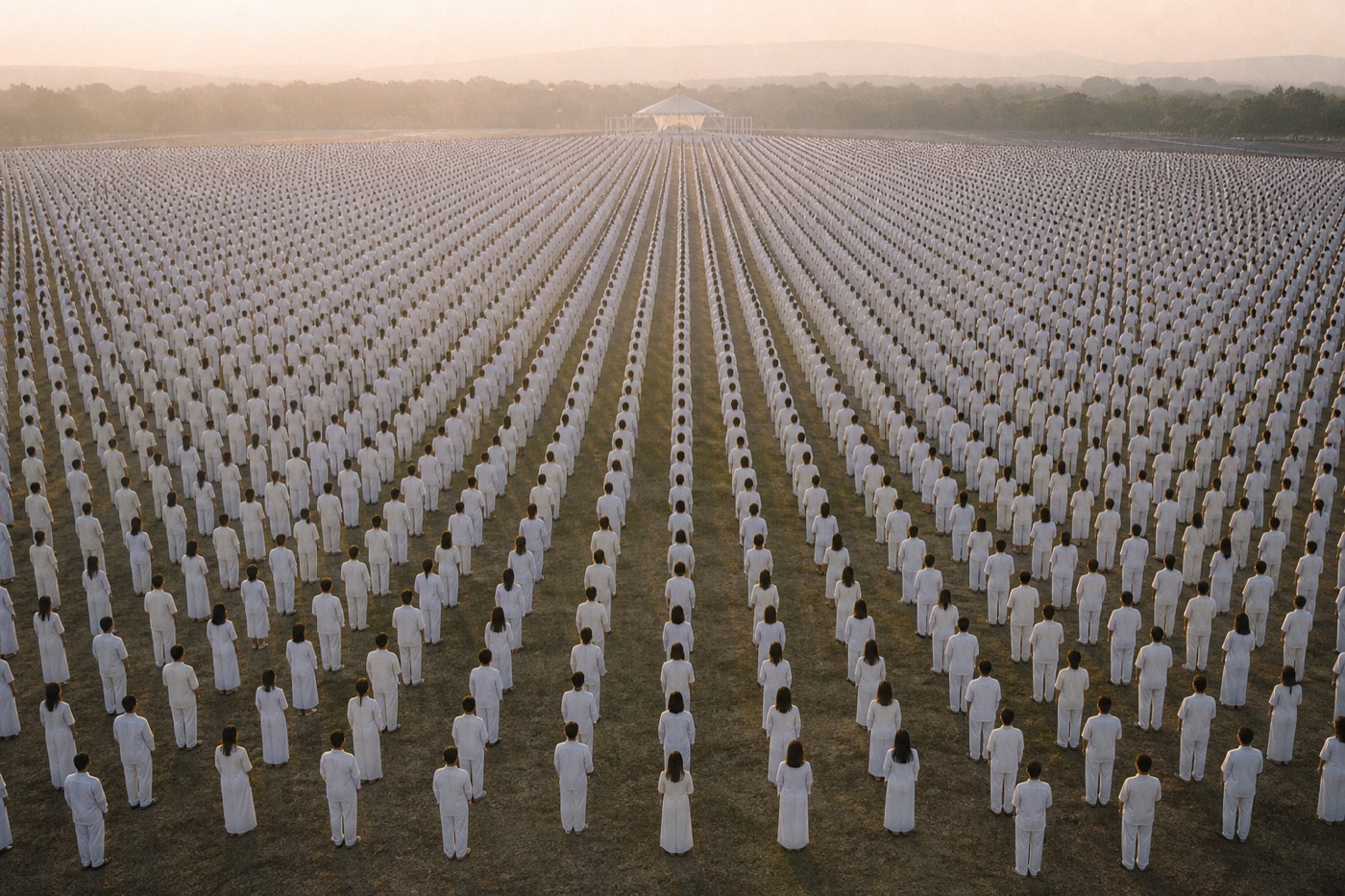
I want to write about the Blessed Remnant carefully, because it is the kind of movement most easily caricatured and least often understood.
The Remnant teaches that a new age dawns through the union of the faithful, and it means union literally: its central rite is a mass blessing of couples, matched and married in a single ceremony, as a foundation for the world to come. It asks total commitment — of time, of money, of self — and its members give it not grudgingly but with a radiance that unsettles visitors expecting to find coercion. The unsettling thing is that it looks like joy.
There is a lazy version of this story that treats intensity itself as the scandal. I don't think intensity is the scandal. Plenty of good lives are intense; plenty of sincere faith asks everything. The question that matters is not how much a movement asks but what it does with what it's given — whether the total devotion is held in trust or spent, whether the member who someday wants to leave is helped to the door or barred from it. The Remnant is young, and that test has not fully come for it.
What I can report is what I saw: a thousand people who had decided, against a world that offered them very little to belong to, to belong completely to each other and to a promise about the dawn. I recognized the decision. I made a version of it once. I am careful, now, about admiring it, and careful about condemning it, and I have not yet met the person wise enough to be sure which the Remnant deserves.