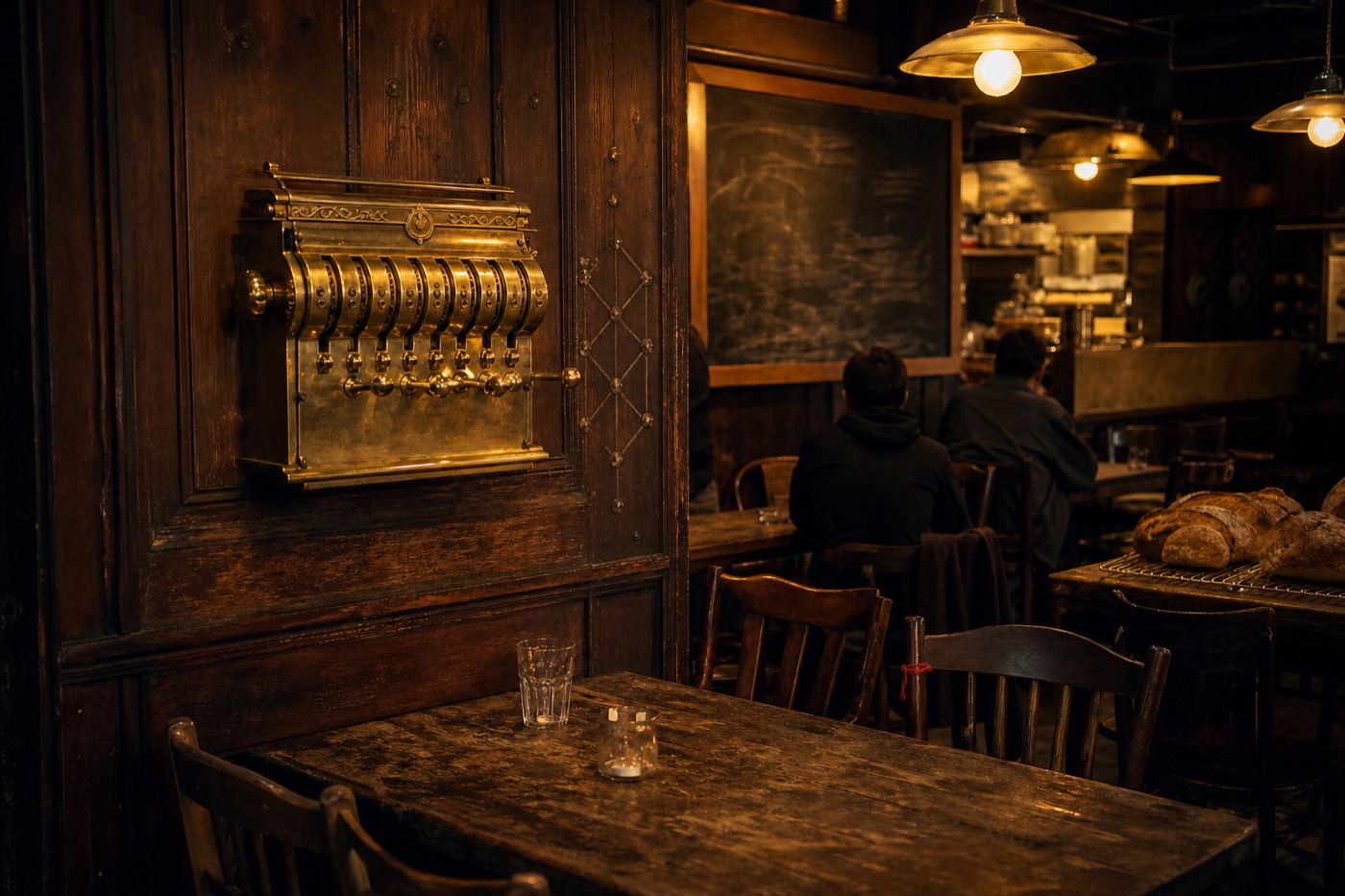
The bread is extraordinary. I want to start there, because everyone who writes about the Golden Bowl starts with the ledger, and the ledger is not what gets you. What gets you is a dim, wood-panelled room that smells of yeast and cardamom, a young man in an apron who looks genuinely glad you came, and a sandwich set down in front of you that you are told, warmly and without conditions, you do not have to pay for. If you have money, there is a box. If you don't, there is no box. Either way you eat, and someone sits with you while you do.
There are eleven of these shops now. They are staffed by members of a messianic sect that calls itself the Menders, and not one of those members has ever drawn a wage.
The theology is where it turns, and it is stranger and more beautiful than the coverage usually allows. The Menders hold, following the kabbalists, that the vessel of creation shattered at the beginning, scattering divine sparks into ordinary matter — into wheat, into oil, into the bodies of strangers. They hold, following the hermeticists, that as it is above so it is below, and therefore that a kitchen is not a metaphor for the cosmos but a working model of it: the oven is the athanor, the dough is prime matter, and the cook who transforms it is performing, at small scale, the operation the world is waiting for. And they hold that every meal placed in the hands of a stranger raises exactly one spark out of matter and returns it. When the last spark is raised, Yeshua returns, the bowl is made whole, and the age ends.
The number of sparks is finite. The Menders believe they know it. And so on the wall of every shop, in polished brass, there is a counter.
This is the part that makes the desk's job difficult, because the counter is genuinely moving and the labor behind it is genuinely free. Members work sixty, seventy hours. They are housed and fed and not paid, on the grounds that a wage would convert a redemptive act into a transaction and forfeit the spark. Their compensation, as it was explained to me several times with great patience, is a share in the count. The doors stay open late. The people who come in late are often the people with nowhere else to be, and a certain number of them do not leave, and the Menders regard that as the mechanism working exactly as designed.
I asked what happens if the count completes and nothing follows. I was told that the count is the faith, and the question was not hostile but simply unavailable — like asking a swimmer what happens if the water stops. What I did establish, from a former member and then from a second, is that the number was revised once, upward, some years ago, after what the elders described as a recalculation. Nobody left over it. The counters were reset overnight and the shops opened at six the next morning, as they always do, with the bread already rising.