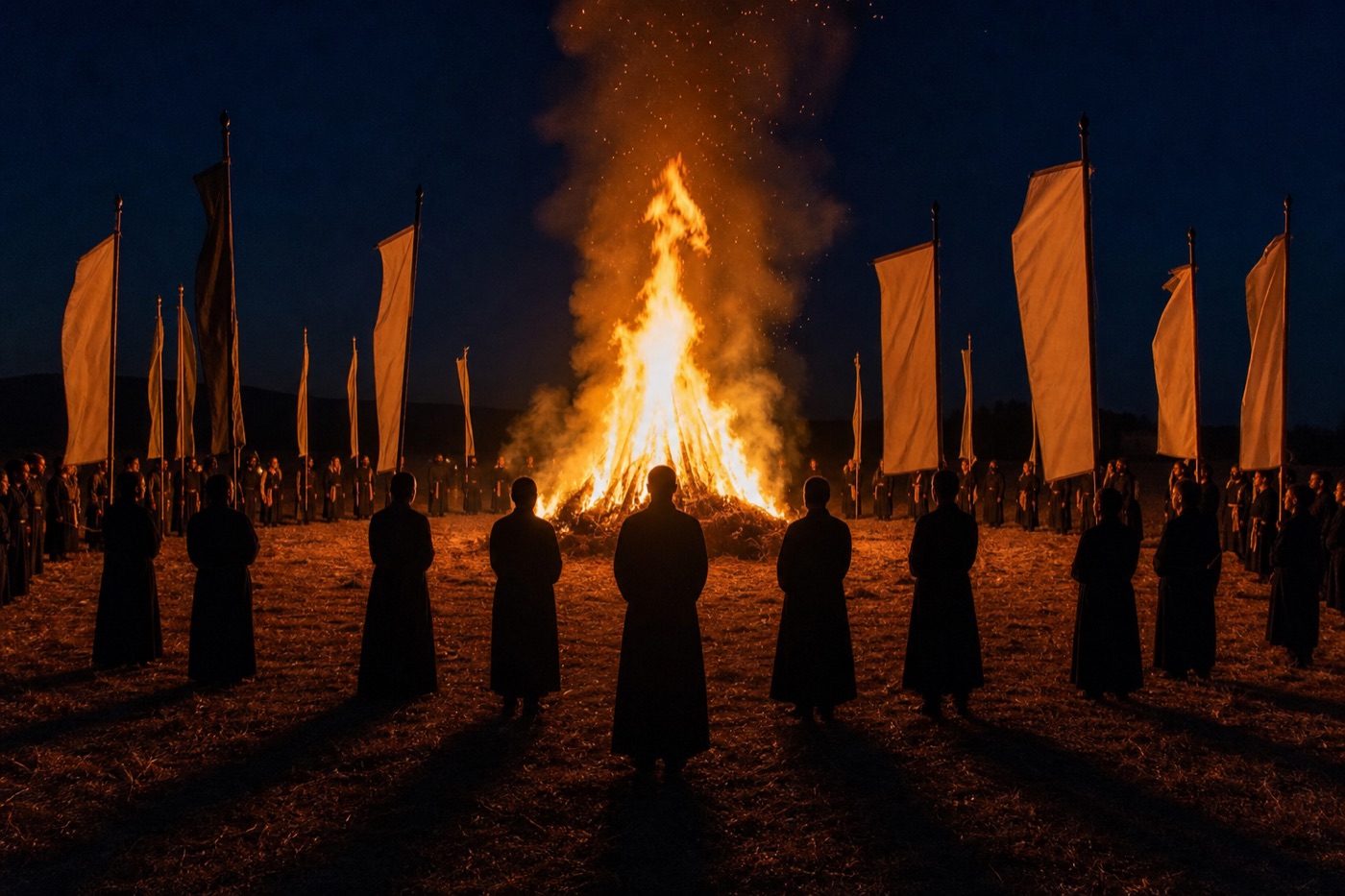
The Sons of the Iron Age take their premise from a genuine idea — that history moves in long descending cycles, and that we live near the bottom of one — and draw from it a conclusion the idea's sources do not: that the faithful should act to hasten the turning. Their teacher, who goes by Acharya Vikram Stone, speaks of "sacred action" and "clearing the ground for the age to come."
It should be said plainly, because the rhetoric invites the fear: the group's "action," to date, has been theatrical rather than violent — dramatic public rites, provocations, a great deal of language about ends and beginnings. Scholars who track apocalyptic militancy watch it closely for exactly that reason: the distance between rhetoric of purifying violence and the practice of it is real, but movements have crossed it before, and the crossing tends to be sudden.
What interests our desk is the theology's structure, which is shared with movements that look nothing like this one. It takes an authentic tradition's patience — the long view that the wheel turns on its own — and replaces it with agency: the wheel turns, but we must turn it, and now. Every movement in our Index that has ever become dangerous made that substitution first. The Sons have made it in the open. Whether they act on it is, for now, the most-watched question on the Eastern desk.